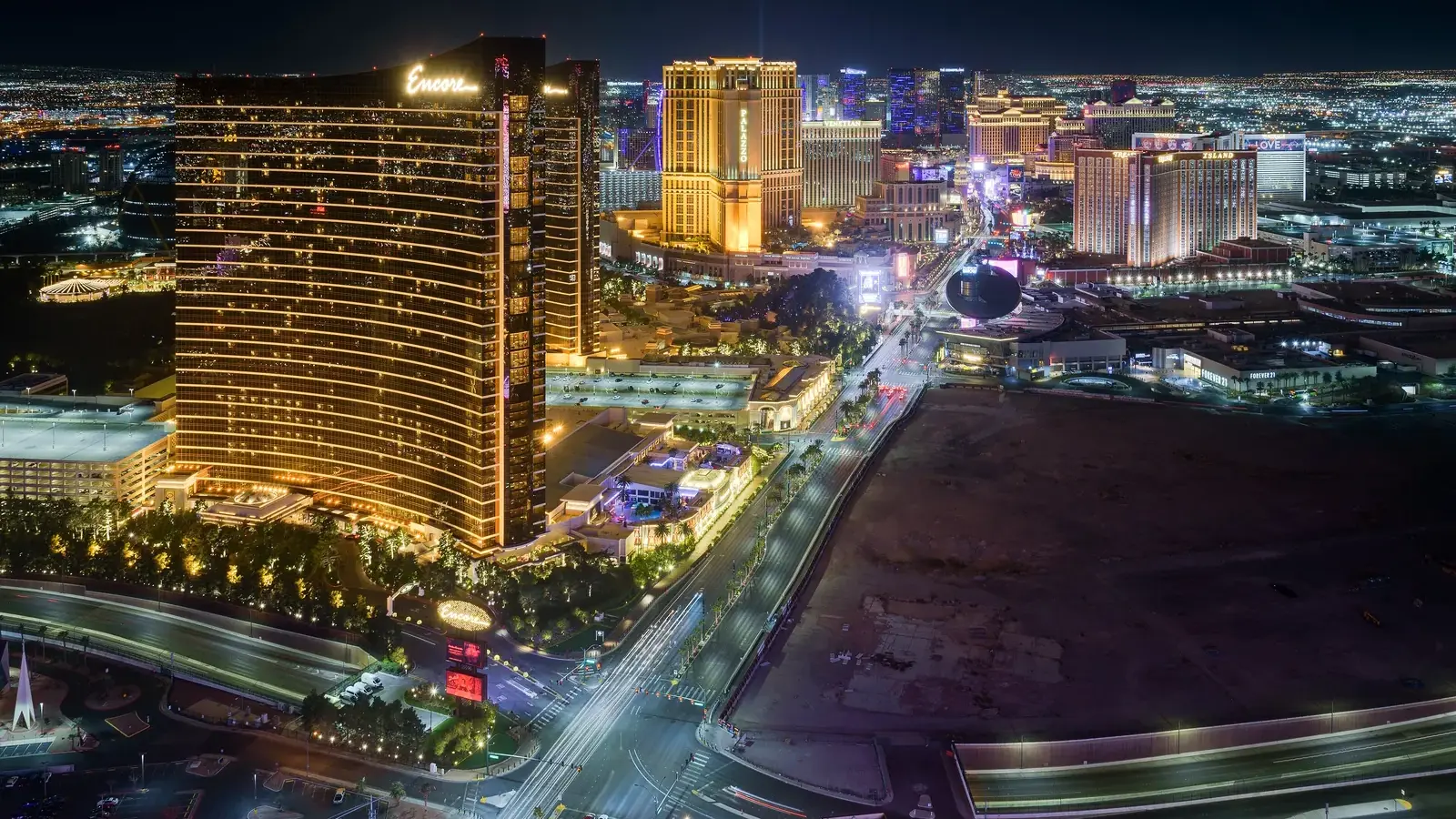
A first time in Las Vegas goes better when you pick the hotel, dates and budget with real numbers in hand. These 25 tips cover the decisions that matter before you book, from how many nights to plan to what the resort fee adds to your bill.
Quick answer
For a first time in Las Vegas, book three nights, ideally on weeknights, at a center-Strip hotel near a Monorail station. Budget with the real nightly cost (room rate plus resort fee plus 13.38% tax), skip the rental car and check your dates against big events such as CES, F1 race week and the National Finals Rodeo.
10 things to know before your first Las Vegas trip
- Book three nights, ideally Sunday to Thursday.
- Stay center Strip, near a Monorail station.
- Budget the room rate plus the resort fee plus 13.38% tax.
- Expect $20 a day to self-park at MGM resorts; Caesars charges too.
- Leave room on your card for a $50 to $150 daily hold.
- Most hotels require the guest checking in to be 21.
- Taxis don’t stop on the street; use a taxi line.
- Buy Monorail tickets online.
- In summer, walk in the morning and evening.
- Set a gambling budget before you land.
You’ll have company in figuring it out: only 10% of 2025 visitors were on their first trip, per the LVCVA. Before you trust an older list, note that The Mirage and Tropicana closed in 2024, Bally’s is now Horseshoe and The Cromwell is now The Vanderpump Hotel. Every number below was checked in October 2026; how we check facts explains the method.
What changed in 2026
- May 22, 2026: The Cromwell reopened as The Vanderpump Hotel, on the center Strip at Flamingo Road.
- Fall 2026: the Monorail closes early on several event dates (at midnight on Oct. 29 and on most nights from Nov. 29 to Dec. 15).
- Through December 2026: lane closures in the airport connector tunnels can slow the ride to and from Harry Reid International Airport.
How many days do you need in Las Vegas?
Three nights is the sweet spot for a first trip. The LVCVA’s 2025 visitor survey found the average stay was 3.2 nights (4.2 days), down from 3.4 nights in 2024, and the Las Vegas Review-Journal’s report on the same study put about 28% of visitors at two nights and another 28% at three.
| Trip length | What fits | Best for |
|---|---|---|
| 2 nights | The center Strip, the Bellagio fountains and one big show | Weekend trips and convention add-ons |
| 3 nights | Add a pool day and an evening on Fremont Street Downtown | Most first-timers |
| 4 nights or more | Add a day trip to Red Rock Canyon, Hoover Dam or the Grand Canyon | Travelers who want the desert as well as the Strip |
Three days is enough for the Strip and Downtown, with time for a pool day in season. Add a fourth night only if you want a day trip, since none of the classic ones can be reached on the Monorail or the Deuce bus.
Before you book: dates and budget
1. Stay on weeknights if you can
In 2025, Las Vegas hotels were 88.8% full on weekends and 76.6% full midweek, according to the LVCVA. Fuller hotels charge more, so a Sunday-to-Thursday stay usually costs less than the same room on a Friday or Saturday.
2. Check the event calendar before you choose dates
A big convention or race weekend can fill the city. The major ones over the next year include the F1 Las Vegas Grand Prix (Nov. 19–21, 2026), the National Finals Rodeo (Dec. 3–12, 2026), CES (Jan. 6–9, 2027) and EDC (May 14–16 and 21–23, 2027). Our guide to the cheapest time to visit Las Vegas has the full calendar and rates by month, and our event guides cover where to stay for the Las Vegas Grand Prix, New Year’s Eve and the NFR.
3. Decide how much heat you can handle
July averages a high of 104.5°F and August 102.8°F, and they were also 2025’s cheapest months for hotel rooms. Spring (March to May) and fall (October and November) bring average highs between about 67°F and 89°F, along with some of the year’s highest rates.
4. Budget with the real nightly cost
The room rate isn’t the bill. On the Strip, add the resort fee and then 13.38% room tax on both. At the Strip’s 2025 average rate of $197.45 and a $49.95 fee, the real cost is $280.50 a night before parking. Our Las Vegas trip cost guide builds full budgets from there.
5. Book a refundable rate early
In the LVCVA’s 2025 survey, 56% of visitors booked more than a month ahead. A free-cancellation rate lets you lock in a room now and rebook if the price drops; just note the cancellation deadline. Our guide to the best way to book a Las Vegas hotel compares booking direct with Booking.com.
Choosing your hotel and area
6. Stay center Strip for your first trip
In 2025, 69% of overnight visitors stayed in the Strip corridor, and for a first trip the center Strip makes the most sense: the Bellagio fountains, Caesars Palace, Paris and the High Roller are all close together. Our guide to where to stay in Las Vegas compares every area, and our ranking of the best hotels in Las Vegas covers the top picks.

Bellagio Las Vegas
- Fountain-view rooms
- Conservatory & gardens
- Five-pool courtyard
Classic center-Strip luxury with the Fountains of Bellagio out front, a free Conservatory and one of the Strip's strongest restaurant line-ups.

Caesars Palace
- Garden of the Gods pools
- The Colosseum
- Forum Shops
Iconic center-Strip resort with the Garden of the Gods pools, The Colosseum, The Forum Shops and a long list of celebrity-chef restaurants.

Paris Las Vegas
- Eiffel Tower replica
- Rooftop pool
- Balcony rooms (Versailles Tower)
Themed center-Strip resort beneath an Eiffel Tower replica, with a rooftop pool, balcony rooms in the Versailles Tower and its own monorail station.

The LINQ Hotel + Experience
- High Roller next door
- LINQ Promenade
- 21+ rooftop pool
Compact, lively hotel at the foot of the High Roller and the LINQ Promenade, with a 21+ rooftop pool and a monorail station next door.
Bellagio and Caesars Palace are the classic first-timer splurges (see our Bellagio review). Paris and The LINQ sit in the mid-range price band, and each has a Monorail station on site or next door.
Prices vary according to travel dates and availability.
7. Don’t judge distances by the skyline
Resorts are enormous, and “next door” can still mean a long walk through a casino. Harrah’s own FAQ puts Caesars Palace 7 to 10 minutes away on foot and Sphere 10 to 15. Multiply that by every trip you make in a day before you book a hotel at the far south or north end of the Strip. Our guides to walking the Las Vegas Strip and which hotels are connected show where you can stay indoors.
8. Book near the Monorail if you’ll move around
The Las Vegas Monorail has seven stations: MGM Grand, Horseshoe & Paris, Flamingo & Caesars Palace, Harrah’s & The LINQ, the Las Vegas Convention Center, Westgate and SAHARA. A hotel on that line makes a car-free trip easy, and our guide to Las Vegas without a car ranks the best bases; the Las Vegas Monorail guide has fares and hours.
9. Consider Downtown for value
Downtown’s average room rate in 2025 was $98.75, about half the Strip’s $197.45. You trade the big Strip resorts for smaller, often historic hotels (the Golden Gate opened in 1906) and Fremont Street’s free canopy shows, which run on the hour from 6 p.m. to 2 a.m. Our Strip vs Downtown comparison helps you decide.
10. If smoke bothers you, choose carefully
Nevada law bans smoking in restaurants, stores and most indoor workplaces but still allows it in casino areas closed to minors and in 21+ stand-alone bars. Park MGM runs a smoke-free casino, and Vdara and Waldorf Astoria are non-gaming, smoke-free hotels. Our non-smoking hotels guide has more options.
Fees to expect: resort fee, tax, parking and deposit
11. Expect a resort fee, plus tax on it
Most hotels add a mandatory nightly resort fee, from $45 to $55 + tax at big Strip resorts as of October 2026, and the 13.38% Strip room tax applies to the fee too, so a $49.95 fee really costs $56.63 a night. Our resort fees guide lists every hotel’s fee with tax.
12. Budget for parking if you drive
As of October 2026, MGM Resorts charges hotel guests $20 a day to self-park and $40 for valet. Caesars resorts charge too, though Caesars Rewards Platinum members and above park free. Downtown is easier: Golden Nugget, The D, Plaza and Downtown Grand include self-parking for hotel guests. Compare hotel by hotel in our Las Vegas parking fees guide.
13. Leave room on your card for the deposit
Expect an incidental hold at check-in, typically $50 to $150 a day or night at the big resorts (as of October 2026); on a debit card, that money leaves your account until it’s released. Our guide to Las Vegas hotel deposits lists the holds hotel by hotel.
14. Check the minimum check-in age
Most Las Vegas hotels require the guest checking in to be 21; Golden Nugget and Westgate allow 18, while Circa and El Cortez admit no one under 21. Our Las Vegas hotel check-in age guide lists 54 hotels’ policies.
15. Don’t count on early check-in
Standard check-in is 3 p.m. at MGM resorts and 4 p.m. at Caesars resorts, and early check-in, when available, can cost extra. MGM resorts, The Venetian and several Caesars hotels hold bags free at the bell desk until your room is ready; our guide to early check-in and luggage storage lists the fees.
Getting around
16. Use taxi lines and rideshare zones
You can’t hail a taxi on the street: taxis pick up only at hotel taxi lines and other set pickup points. From the airport, flat fares to the Strip are $22.25, $26.25 or $30.25 depending on the zone, plus $3 if you pay by card and a 3% excise tax; our airport-to-Strip guide lists the fare for every hotel.
At the airport, Uber and Lyft pick up in the parking garages: Level 2 at Terminal 1 and the Valet Level at Terminal 3. At big resorts the pickup zone is often in the garage too (Caesars Palace’s is inside its parking garage), so allow a few extra minutes.

17. Buy Monorail tickets online
Online eTickets cost $5.75 a ride or $13.95 for a day, against $6.25 and $15.50 at station machines, and three rides make the day pass worth it. Trains run from 7 a.m. until midnight on Mondays, 2 a.m. Tuesday through Thursday and 3 a.m. Friday through Sunday.
18. Use the Deuce to get Downtown
The Monorail doesn’t go Downtown. The RTC’s Deuce bus runs 24 hours along the Strip and Downtown; a ride costs $4 and a 24-hour pass $8, and you’ll need exact fare if you pay on board. Our guide to getting from the Strip to Fremont Street compares the Deuce with taxis and rideshare.
19. Rent a car only for day trips
You won’t need a car between the Strip and Downtown, and hotel parking adds up. For Hoover Dam, Red Rock Canyon or the Grand Canyon, rent for that day only: the airport’s Rent-A-Car Center houses 10 rental companies and is open 24/7.
Money, gambling and house rules
20. 21 means 21
You must be 21 to gamble or drink in Nevada, and under-21s aren’t allowed to loiter in gaming areas. That matters for families: 14% of 2025 visitor parties included someone under 21.
21. Set a gambling budget before you land
The average gambler’s trip budget in 2025 was $848.95, according to the LVCVA. Treat whatever you bring as entertainment money you can afford to lose. If gambling stops being fun, the problem-gambling helpline is 1-800-522-4700.
22. Carry small bills for tips
No hotel or tourism office publishes tip amounts, so the commonly suggested ones come from Las Vegas Advisor: $2 to $3 a night for housekeeping, $1 to $2 a bag for bell staff, $3 to $5 when a valet brings your car and $1 a drink for casino cocktail servers. Las Vegas Advisor notes that Nevada gaming rules bar casinos from accepting chips as payment outside gaming, so keep cash handy; our guide to how much to tip in Las Vegas covers dealers and drivers.
23. Do the free stuff first
The Fountains of Bellagio run every 30 minutes from 3 p.m. on weekdays (from noon on weekends and holidays) and every 15 minutes from 8 p.m. to midnight, according to Bellagio. The Bellagio Conservatory is free and changes its display five times a year, and Fremont Street’s canopy shows run on the hour from 6 p.m. to 2 a.m. The LVCVA keeps a longer list of free things to do in Las Vegas.

Weather, dress codes and what to pack
24. Check the dress code before a club or fine dining
Casinos don’t publish a dress code, but nightclubs and upscale restaurants do. Tao Group’s clubs, including Marquee at The Cosmopolitan and Hakkasan at MGM Grand, strongly encourage upscale nightlife attire and don’t permit sports attire, athleisure or swimwear, and Wynn’s Wing Lei asks for business casual.
25. Pack for heat, chilly nights and a lot of walking
Las Vegas averages 78 days a year at 100°F or hotter, and the record is 120°F, set on July 7, 2024. Winter goes the other way: December lows average 39.6°F, and the coldest nights drop into the 20s. Whatever the season, pack comfortable walking shoes and a refillable water bottle, and in July and August watch for monsoon storms that can flood normally dry washes. Don’t count on a coffee maker or a free fridge in a big Strip room; our guide to hotel rooms with a fridge, microwave or coffee maker has the details, and our Las Vegas packing list goes month by month.
Sample 3-day plan for first-timers
Day 1: Arrive and walk the center Strip. Take a flat-fare taxi from the airport and drop your bags if your room isn’t ready. Spend the evening at the Bellagio Conservatory and the fountains, which run every 15 minutes after 8 p.m.
Day 2: Pool, wheel and a show. Spend the morning at the pool in season, or catch the free Fall of Atlantis show at the Forum Shops (hourly from noon). Ride the High Roller after 6 p.m. ($34.75, plus taxes and fees), then see a show such as “O” at Bellagio or The Wizard of Oz at Sphere.
Day 3: Downtown. Take the Deuce to Fremont Street in the late afternoon, walk the five-block Fremont Street Experience and stay for the canopy shows on the hour. The Deuce runs all night, so getting back is easy.

Day 4: Head home. Checkout is 11 a.m. at the resorts above. Leave extra time for the airport: lane closures in the airport connector tunnels run through December 2026.
FAQ
Is 3 days enough in Las Vegas?
Yes, for a first trip focused on the Strip and Downtown. Three nights matches how most visitors travel (the 2025 average was 3.2 nights) and leaves time for the center-Strip sights, a pool day or show and an evening on Fremont Street. Add a fourth night for a day trip to Hoover Dam, Red Rock Canyon or the Grand Canyon.
Do you need a car in Las Vegas?
Not for the Strip or Downtown. The Monorail, the 24-hour Deuce bus, free trams between some resorts, taxis and rideshare cover the tourist core, and skipping the car saves parking fees, such as the $20 a day MGM resorts charge hotel guests. Rent one only for day trips.
Are resort fees included in my booking?
They should be in the total price you see. Since May 12, 2025, the FTC has required hotels and booking sites to show a total that includes mandatory fees such as resort fees, though taxes can be shown separately. Check the price breakdown before you pay to see whether the fee is prepaid or charged at the hotel.
How old do you have to be to check in to a Las Vegas hotel?
Usually 21. A few hotels, including Golden Nugget and Westgate, allow 18, while adults-only Circa and El Cortez admit no one under 21. Our guide to the Las Vegas hotel check-in age has every hotel’s policy.
What should you not do in Vegas the first time?
Don’t book on the headline rate alone, choose a far-end hotel without checking walking distances, try to hail a cab on the street or buy Monorail tickets at the machine when online eTickets cost less. In summer, don’t plan long midday walks: July’s average high is 104.5°F.
What should I pack for Las Vegas?
Comfortable walking shoes, a refillable water bottle and sun protection year-round, a swimsuit from spring to early fall and a warm layer from November through February, when average lows run from about 40°F to 47°F. Pack something dressier if you plan on nightclubs or fine dining; see what to pack for Las Vegas for the full list.
More hotel choices for your trip
Photo credits
- Photo: King of Hearts, CC BY-SA 4.0 via Wikimedia Commons
- Photo: pelican, CC BY-SA 2.0 via Wikimedia Commons
- Photo: Christian David, CC BY-SA 4.0 via Wikimedia Commons
- Photo: pelican, CC BY-SA 2.0 via Wikimedia Commons
- Photo: Tomás Del Coro, CC BY-SA 4.0 via Wikimedia Commons
- Photo: Han Zheng, CC BY-SA 2.0 via Wikimedia Commons
- Photo: Alberto-g-rovi, CC BY 3.0 via Wikimedia Commons